Want a sharper jawline or a fresh, glowing face? You have probably seen two major trends taking over your social media feeds: microcurrent devices and Gua Sha tools. Both promise to lift, sculpt, and tone your skin without a trip to a plastic surgeon. But when you look at them closely, they use completely different methods to get you there.
One relies on high-tech electrical pulses, while the other is an ancient hands-on massage tradition. It can be confusing to pick the right one for your daily routine. Let us dive right into how these methods work, what they do for your skin, and which one deserves a spot on your vanity.
Key Takeaways
If you are in a rush, here is the quick breakdown of how these two facial sculpting methods match up against each other.
- Microcurrent is a high-tech workout for your face that uses low-level electrical currents to tone your facial muscles. It is ideal for lifting sagging areas and firming the skin quickly.
- Gua Sha is an ancient Chinese massage technique using a smooth stone tool to move fluid and release muscle tension. It is perfect for reducing puffiness and giving your skin a natural, healthy glow.
- The Big Difference comes down to what they target. Microcurrent focuses on the muscles underneath your skin, while Gua Sha focuses on the skin tissue, blood flow, and fluid buildup.
- Best Results actually come from mixing both, as long as you do not use them at the exact same moment. They fix different problems, so they can assist each other beautifully.
What Is Microcurrent Facial Sculpting?
Microcurrent technology might sound like science fiction, but it is actually a well-studied method that has been around for decades. It started in the medical world to treat people with facial paralysis before it became a favorite tool in the beauty world.
The Science Behind the Current
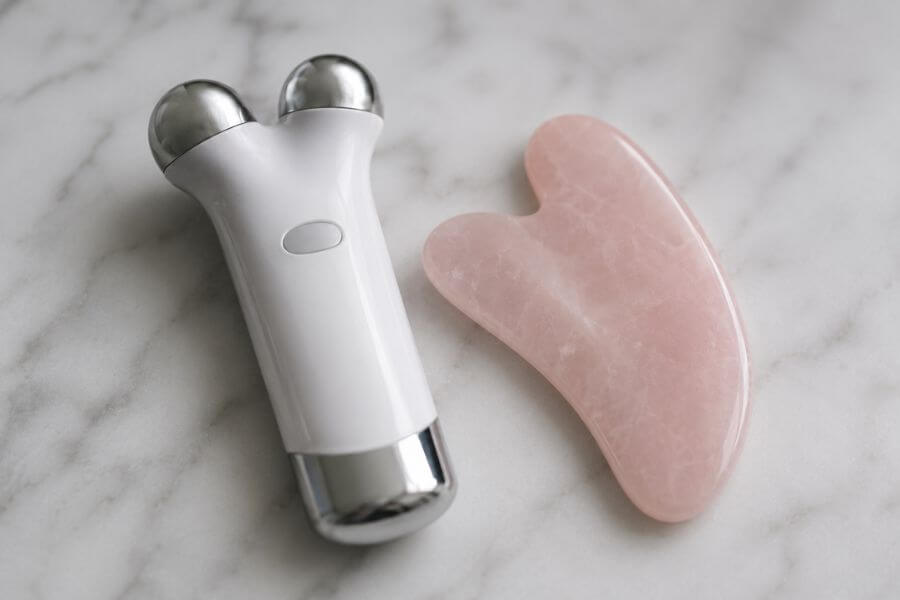
Your body naturally runs on electricity. Microcurrent devices use low-voltage electrical currents that mimic your body’s own natural signals. When you press the metal spheres of a device against your skin, these tiny currents pass through your skin layers down into your facial muscles.
The main goal here is to stimulate a molecule called adenosine triphosphate, which people usually just call ATP. This molecule acts like fuel for your cells. By boosting ATP, the current tells your cells to speed up their natural repair process, create more structural proteins, and contract the muscles.
How It Acts Like a Facial Workout
Think about going to the gym to lift weights. When you workout, your muscles become firmer, tighter, and more defined. A microcurrent device does the exact same thing for your face.
The electrical pulses gently shock the muscles, forcing them to contract and relax. Over time, this constant stimulation trains the muscles to hold a higher, firmer position. This gives your face a lifted look, especially around your eyebrows, cheekbones, and jawline.
What to Expect During a Session
Using a microcurrent tool is generally a comfortable experience. You must always apply a thick layer of a special water-based gel first. This gel acts as a path for the electricity to travel safely into your skin.
If you use enough gel, you will not feel much of anything. You might feel a slight tingling sensation, or you might see your muscles twitch a little bit around your eyes or mouth. If you run out of gel during the process, you might feel a sharp pinch, which is a reminder to add more moisture.
The Pros and Cons of Microcurrent
Every skincare tool has its bright sides and its dark sides. Knowing what to expect can help you decide if a high-tech device fits into your lifestyle and budget.
The Benefits of Electrical Toning
- Fast Results: You can often see a visible lift in your cheeks and brows immediately after a single five-minute treatment.
- Deep Muscle Control: It goes past the surface of your skin to change the actual shape of the muscles underneath.
- Collagen Support: The boost in cellular energy helps your skin produce more collagen, which keeps your face looking bouncy and youthful.
- Fine Line Smoothness: As the muscles tighten, the skin on top stretches slightly, which helps minimize the look of small wrinkles.
The Downsides of Going High-Tech
- High Price Tag: Quality microcurrent devices are expensive investments that require a good amount of money upfront.
- Constant Upkeep Needed: The lifted look is temporary. If you stop using the device for a week or two, your muscles will return to their original state.
- Gel Replacement Costs: You cannot use these tools dry. You must continuously buy the conductive gel, which adds to the long-term cost.
- Battery and Tech Issues: Like a smartphone, these devices can break, lose battery life, or experience technical errors over time.
What Is Gua Sha Facial Sculpting?
Gua Sha is a beautiful, traditional practice rooted in ancient Chinese medicine. It has been used for centuries to heal the body, clear out bad energy, and improve blood circulation. While it was originally used heavily on the back and body, the facial version is much more gentle.
The Philosophy of Flow
In traditional practices, health is all about balance and flow. Gua Sha translates roughly to “scraping away redness” or “scraping away sickness.” When used on the face, the goal is to break up stagnation, which is just a fancy word for trapped fluid, energy, or blood.
By using light pressure and specific strokes, you help move lymphatic fluid away from your face and down toward your neck. This fluid movement helps clear out waste products from your skin cells, leaving your face looking refreshed and clean.
The Tools of the Trade
Unlike microcurrent, which requires wires or batteries, Gua Sha relies on a simple, beautiful stone. These tools are usually carved from natural crystals like jade, rose quartz, or amethyst. Each stone is shaped with smooth curves, notches, and flat edges designed to hug the different angles of your face.
Jade is traditionally chosen because it stays naturally cool to the touch and represents healing balance. Rose quartz is often linked to love and calming energy. The material you choose does not change the physical results, so you can pick whichever stone makes you feel best.
How to Perform the Technique
You should never use a Gua Sha tool on dry skin because it will tug and damage your face. Instead, you start by applying a generous amount of face oil. This gives the stone a slippery surface to glide across smoothly.
You hold the stone at a flat angle against your skin, rather than straight up and down. Then, using light to medium pressure, you sweep the stone upward and outward. You start at the neck, move to the jaw, slide across the cheeks, and finish at the forehead, always moving toward the outer edges of your face.
The Pros and Cons of Gua Sha
Gua Sha has taken over the wellness world for good reason, but it still requires some effort and patience to master. Here is a look at the good and bad parts of this traditional method.
The Benefits of Stone Massage
- Incredible De-Puffing: It is unmatched when it comes to draining excess fluid, making it perfect for groggy mornings.
- Relaxation and Stress Relief: The slow, mindful strokes help melt away tension in your jaw and forehead, acting like a mini spa visit.
- Low Cost: You only need to buy the stone once. As long as you do not drop and crack it, it will last forever.
- Better Product Absorption: The sliding motion helps press your favorite face oils and serums deeper into your skin.
The Downsides of the Manual Sweep
- Slower Muscle Results: It does not contract your muscles, so it takes a lot longer to see true structural lifting.
- Risk of Acne Breakouts: Using heavy face oils for the massage can clog pores if you are already prone to pimples.
- Requires Good Technique: If you push too hard or hold the stone at the wrong angle, you can cause bruising or broken blood vessels.
- Fragile Equipment: Natural crystal stones will shatter easily if they slip out of your oily hands onto a hard bathroom tile floor.
Side-by-Side Comparison
To help you see how these two methods stack up in daily life, let us look at their features next to each other.
| Feature | Microcurrent Devices | Gua Sha Stones |
| Primary Mechanism | Low-voltage electrical current | Manual sweeping friction and pressure |
| Main Target Area | Deep facial muscles | Skin surface and lymphatic fluid |
| Average Initial Cost | High ($150 to $500) | Low ($10 to $40) |
| Required Medium | Water-based conductive gel | Face oil or rich serum |
| Time Needed Per Day | 5 to 20 minutes | 5 to 10 minutes |
| Power Source | Rechargeable battery or wall plug | None (purely manual) |
| Best For | Lifting sagging skin and tightening | Reducing puffiness and relaxation |
Deep Dive into the Differences
While both methods promise a more sculpted face, they achieve that goal through completely separate pathways. Understanding these differences will help you figure out what your face actually needs right now.
Muscle Stimulation vs. Lymphatic Drainage
The absolute biggest difference lies in what happens under your skin during treatment. Microcurrent bypasses the top layers of skin to talk directly to your muscles. It forces those muscles to tighten up, creating a structural lift from the inside out.
Gua Sha does not affect the muscle shape in that way. Instead, it works on the fluid networks directly under your skin surface. Your face holds onto a lot of excess fluid, especially after you sleep. Gua Sha physically pushes that fluid away, which slims down your face by removing the bloat.
Immediate Results vs. Long-Term Glow
If you have a big party tonight and want your cheekbones to pop instantly, microcurrent is your best bet. The electrical lift happens almost right away because the muscles tighten up in response to the current. However, that lift will fade by tomorrow morning.
Gua Sha gives you a different kind of instant result by removing puffiness, but its real magic shows up over time. The repeated scraping increases blood flow to your skin surface. This brings fresh oxygen and nutrients to your face, creating a bright, glowing complexion that looks healthier every single week.
High-Tech Precision vs. Mindful Wellness
Using a microcurrent tool feels like using a tech gadget. You have to charge it, press buttons to change the intensity levels, and listen for timing beeps. It is a goal-oriented process focused purely on the physical results.
Gua Sha is a sensory ritual. The cool touch of the stone, the scent of your face oil, and the slow rhythm of the strokes make it a meditative experience. It helps calm your nervous system, making it an amazing way to unwind after a stressful day.
How to Choose the Best Method for Your Skin
You do not have to flip a coin to decide which tool to buy. You can look at your specific skin concerns, your daily habits, and your budget to make the perfect choice.
Choose Microcurrent If
- You are noticing early signs of sagging skin around your jaw or cheeks.
- You want an instant lift for photos or special events.
- You love beauty gadgets and do not mind charging your tools.
- You have the budget to spend on a premium device and regular gel refills.
- Your main goal is anti-aging and firmness.
Choose Gua Sha If
- You wake up with a swollen, puffy face most mornings.
- You carry a lot of stress in your jaw and clench your teeth.
- You prefer a natural, calm skincare routine without electronics.
- You want to spend a small amount of money for a tool that lasts.
- Your main goal is a bright complexion and fluid drainage.
Can You Use Both Together?
If you are sitting there wishing you could have the muscle-toning power of microcurrent and the relaxing, de-puffing benefits of Gua Sha, there is great news. You absolutely can use both in your weekly routine. In fact, combining them can give you incredible results.
The Golden Rule of Combining
The most important rule is that you must never use them at the exact same time or on top of the same products. Microcurrent requires oil-free, water-based gel so the electricity can flow. Gua Sha requires slippery face oil so the stone does not scratch your skin. If you mix oil and microcurrent, the current will block, and you might get a painful zap.
Setting Up a Weekly Schedule
A great way to mix these methods is to split them between your morning and evening routines. You can use Gua Sha in the morning to drain away nighttime puffiness and wake up your glow. Then, you can use your microcurrent device at night after washing your face to lift and tone your muscles before bed.
If that feels like too much work for one day, you can rotate them by days. You can use your microcurrent tool three times a week for your heavy workout sessions, and use your Gua Sha stone on the alternating days to soothe your skin and relax your muscles.
Frequently Asked Questions
Will microcurrent or Gua Sha hurt my face if I use them incorrectly?
Neither method should cause pain if you follow the instructions. Microcurrent will only pinch or sting if you fail to use enough conductive gel. Gua Sha should never cause pain or heavy red marks on your face. If your skin turns bright red or hurts, you are pushing way too hard with the stone. Always keep the stone flat and use a light, gentle touch.
Can I use regular water instead of conductive gel for my microcurrent device?
No, plain water will not work correctly. Water evaporates too quickly and does not contain the special ions needed to carry the electrical current safely into your muscles. If you try to use plain water, the current will stay on the surface of your skin and cause uncomfortable stinging rather than reaching the muscles underneath.
How do I clean and store my Gua Sha stone safely?
Since you use oil with your Gua Sha stone, it can quickly collect bacteria if left unwashed. After every single use, wash your stone with warm water and a gentle antibacterial soap. Dry it completely with a clean towel. Store it in a soft pouch or a box so it does not get scratched or fall off your counter and break.
Are these facial sculpting tools safe to use if I have active acne?
If you have active breakouts, you need to be very careful. You should never run a Gua Sha stone over raised pimples, because the friction can pop them and spread bacteria around your face. Microcurrent is generally safe, but passing the metal spheres over open sores or angry acne can cause irritation. It is best to work around problem areas until your skin clears up.
Can teenagers use microcurrent devices and Gua Sha tools?
Teenagers can safely enjoy Gua Sha because it is just a gentle facial massage that helps with morning puffiness and relaxation. Microcurrent devices, however, are generally not necessary for teenagers. Teen muscles and skin cells already have high amounts of natural energy and collagen, so a microcurrent tool will not show much of a difference on young skin.
How long do the results last if I stop using these methods completely?
The results from both methods are temporary. If you stop using your microcurrent device, your facial muscles will gradually lose their extra tone and return to their normal shape within a few weeks. If you stop doing Gua Sha, your face will hold onto daily fluid and puffiness just like it did before you started the practice. Consistency is the secret to keeping your results.