Key Takeaways
- Undertone is Permanent: Your surface skin color changes with the sun, but your undertone stays exactly the same your entire life.
- Three Main Categories: Everyone fits into a cool, warm, or neutral category. Knowing yours stops your foundation from looking orange or gray.
- The Quick Tests: You can easily find yours by looking at your wrist veins, trying on jewelry, or wearing a plain white t-shirt.
- The Magic Formula: Perfect shade matching means finding your depth level (fair to deep) plus your undertone (cool, warm, or neutral).
Ever bought a foundation that looked amazing in the store, only to get home, put it on, and realize you look like an orange or a ghost? You are not alone. This happens because most people pick their makeup based only on how light or dark their skin is on the surface. To get a seamless match that blends right into your neck, you have to look deeper. You need to discover your skin undertone.
Let us dive right into what this means and how you can find yours today.
What is an Undertone anyway
To master your makeup, you must understand that your skin has two layers of color. The first layer is what you see when you look in the mirror. This is your surface shade. It can be light, medium, tan, or deep. Your surface shade changes all the time. If you spend a weekend at the beach, your surface shade gets darker. If you stay inside all winter, it gets lighter.
Your undertone is the quiet color that lives just beneath that surface layer. It never changes. You are born with it, and it stays the same whether you have a tan or have not seen the sun in months. Think of your surface shade like a t-shirt you can change, while your undertone is your actual skin underneath.
The Three Big Groups
Almost every human being on earth fits into one of three main undertone groups.
- Cool: Your skin has hints of blue, pink, or red underneath.
- Warm: Your skin has hints of yellow, peach, or golden tones.
- Neutral: Your skin is a perfect mix of both, or it matches your surface color closely without leaning pink or yellow.
Why Surface Color Trays You
Many people think that if you have very pale skin, you must have a cool undertone. They also think that if you have dark skin, you must have a warm undertone. This is a massive myth.
You can have dark brown skin with a very cool, blue-ish undertone. You can also have pale alabaster skin with a warm, golden-yellow undertone. If you ignore this, you will keep buying the wrong makeup.
Quick Group Comparison
| Undertone Group | Hidden Colors | How it Reacts to Gold | How it Reacts to Silver |
| Cool | Pink, Red, Blue | Can look harsh or yellow | Looks bright and fresh |
| Warm | Yellow, Peach, Gold | Looks rich and glowing | Can look dull or cold |
| Neutral | Olive, Balanced | Looks great | Looks great |
The Great Vein Test
This is the most famous method to find your undertone, and you can do it right now. All you need is some natural light. Walk over to a window or step outside. Do not use the yellow lights in your bathroom because they will trick your eyes.
Flip your wrists over and look closely at the tiny lines where your blood flows. Those are your veins.
If Your Veins Look Blue or Purple
If those lines under your skin look clearly blue, or if they have a purple tint, you belong to the cool club. This means the shadow under your skin is leaning toward the chilly side of the color wheel. When you look at makeup bottles later, you will want to look for labels that mention pink or cool shades.
If Your Veins Look Green or Olive
If your veins look greenish, you have a warm undertone. Now, your blood is not actually green. What you are seeing is a yellow-toned skin surface resting over blue veins. Yellow and blue mix together to create green. So, green veins mean your skin has a natural golden or yellow warmth to it.
If You Can not Tell the Difference
If you look at your wrists and think some look blue but others look green, or if they just look like the color of your skin, you are neutral. This means you do not have a strong yellow or pink push underneath. You sit right in the middle, which gives you a lot of flexibility with your makeup choices.
The White Shirt Challenge
This test is wonderful because it uses contrast to show you the truth about your skin. For this experiment, you need to find a piece of clothing that is pure, bright white. A plain white t-shirt or even a white bath towel works perfectly. Wash your face completely so you have zero makeup on, and pull your hair back.
Standing in the Light
Hold the pure white fabric right under your chin and look in a mirror while standing in natural sunlight. Notice how your face looks against that bright white background.
Reading the Results
- You look pink or blue: If your face suddenly looks a bit rosy, red, or slightly blue next to the white cloth, you are cool.
- You look yellow or orange: If your face looks golden, creamy, or slightly yellow, you are warm.
- You look grey or washed out: If you do not see pink or yellow, but you feel the white cloth makes you look a bit dull, you might be neutral or even olive.
The Off-White Trick
If you still feel confused, grab a piece of clothing that is off-white, cream, or ivory. Hold that under your chin. If you look amazing and glowing in cream, but washed out in pure white, you are almost certainly warm-toned. If pure white makes you pop but cream makes you look dirty, you are cool-toned. Neutral folks can usually wear both without any issues.
The Jewelry Matching Game
Most people already know what kind of jewelry they like to wear, but you might not know that your skin is making that choice for you. The metals you wear look good because they either match or clash with your undertone.
Silver versus Gold
Find a piece of shiny silver jewelry and a piece of bright gold jewelry. Hold them over the back of your hand or against your neck.
What the Metals Tell You
- Silver shines bright: If silver makes your skin look alive, healthy, and awake, your skin loves cool tones. Gold might look a bit heavy or dirty on you.
- Gold glows bright: If gold melts into your skin and makes you look like a sun-kissed royal, you have warm skin. Silver might look cheap or cold against you.
- Both look wonderful: If you can wear a gold ring on one hand and a silver bracelet on the other without either looking strange, you are neutral.
The Sun Reaction Test
Think about what happens to your skin when you step outside into the hot summer sun without any sunscreen for a little bit. How your skin behaves under the sun tells a big story about your genetics and your undertones.
The Burners
If you go outside and turn as red as a tomato within fifteen minutes, you are a cool-toned person. People with cool undertones usually have less melanin on the surface, which lets the pink blood vessels show through faster when the skin gets hot or irritated.
The Tanners
If you can walk outside and immediately turn a beautiful golden brown without ever getting red or sore, you are warm-toned. Your skin naturally produces the kind of pigment that blends with golden light, which protects the skin surface and shifts it into a deeper bronze shade quickly.
The Burn and Tan Mix
If you get a little red at first, but then that redness turns into a tan after a day or two, you are likely neutral. Your skin has a balance of pigments that react to the sun with both cool inflammation and warm protection.
The Secret Olive Category
There is a special group that often gets left out of the main three, and it causes so much confusion. This is the olive undertone. Olive skin is actually a sub-category of neutral or warm skin, but it has a very specific green or gray tint to it.
How Olive Works
Olive skin happens when you have a yellow undertone mixed with a tiny bit of blue. As we learned in school art class, yellow and blue make green. If you have olive skin, you might find that warm foundations look too yellow on you, and cool foundations look way too pink.
Spotting Olive Skin
People with olive skin often look amazing in earth tones like hunter green, muted gray, and deep brown. If you feel like every foundation you buy looks either too orange or like a mask of pink clay, look for shades labeled as olive or neutral-warm.
Decoding Makeup Bottles
Now that you know your group, you need to understand how makeup companies name their products. Walking up to a makeup counter can feel like looking at a wall of secret codes. Let us break down those codes.
Letters and Numbers
Many professional brands use a letter system on their bottles. You will see things like NW20, NC30, or 3N1.
- C stands for Cool: Designed for pink and blue undertones.
- W stands for Warm: Designed for yellow and golden undertones.
- N stands for Neutral: Designed for balanced skin.
Watch Out for Brand Swaps
Here is a tricky part: some brands swap the meanings. For example, a few famous brands use “C” to mean cool-warm because they think of yellow as a cooling color for redness. Always read the description on the brand website before buying. If the description says “Cool with pink tones,” then you know you are on the right track if you are cool-toned.
Common Color Names on Labels
| Cool Labels | Warm Labels | Neutral Labels |
| Alabaster | Ivory | Nude |
| Porcelain | Vanilla | Buff |
| Rose | Sand | Classic Ivory |
| Cocoa | Honey | Natural |
| Sable | Amber | Espresso |
The Perfect Match Method
You are now ready to go to the store and find your perfect foundation match. Do not just smear makeup on your hand or your wrist. The skin on your hand is a completely different color than the skin on your face.
The Three-Line Swatch Test
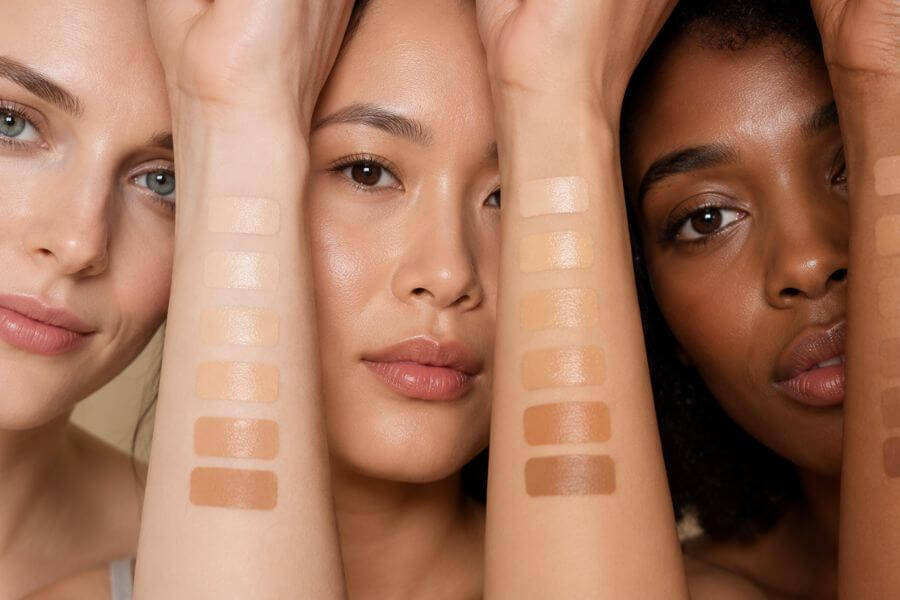
To get the ultimate match, you want to test three different shades at the exact same time. Pick the shade you think is your perfect match, one shade that is a little lighter, and one shade that is a little darker.
Where to Swatch
Draw three clean lines of makeup starting from your lower cheek, moving down over your jawline, and ending slightly on your neck.
Let it Dry
This is a step that everyone skips, and it ruins their results. You must wait at least five to ten minutes for the makeup to dry down. Many foundations oxidize. This is a big science word that just means the makeup reacts with the air and the oils on your face and turns darker or more orange as it dries.
The Disappearing Act
Take a small hand mirror and walk outside into the natural light. Look at the three lines on your jaw. The correct shade will literally disappear into your skin. It will look like you did not even put anything there. If a line looks like a stripe of paint, that bottle is wrong for you.
Fixing Mistakes You Already Made
If you have a drawer full of wrong foundation shades that you spent your hard-earned money on, do not throw them away. You can save them using color theory.
If Your Foundation is Too Yellow
If you bought a warm foundation but you are cool-toned, your face will look orange or yellow. You can fix this by buying a blue or purple color-correcting drop. Adding a tiny dot of blue mixer into your yellow foundation will neutralize the warmth and bring it back to a cool or neutral shade.
If Your Foundation is Too Pink
If your makeup looks gray, chalky, or too pink, it means it lacks warmth. You can fix this by mixing in a tiny drop of a yellow color-corrector or even a tiny drop of a liquid bronzer. This adds the golden sunshine back into the product so it matches your warm skin.
Shifting Shades for the Seasons
If you bought a shade that matches your undertone but is just a little too dark because it is winter, do not panic. Mix it with a bit of your favorite face moisturizer. This thins out the pigment and makes it lighter on your skin, while giving you a beautiful glow.
Frequently Asked Questions
Can my skin undertone change if I get a bad sunburn or a deep tan?
No, your undertone will never change. Even if you get a very dark tan from spending weeks at the pool, the root colors under your skin remain exactly the same. Your surface color gets darker because of melanin, but your cool, warm, or neutral base stays constant throughout your entire life.
Why does my foundation look perfect inside the bathroom but orange outside?
This happens because of the type of light bulbs used in most houses. Warm, yellow bathroom lights hide the yellow and orange tones in makeup. When you step outside into clear, white daylight, the true color of the product is revealed. Always check your foundation match next to a bright window before wearing it out.
I have a lot of red acne on my cheeks. Does that mean I have a cool undertone?
Not necessarily. Acne, rosacea, and skin irritation are surface conditions that cause redness. This can trick you into thinking you are cool-toned when you might actually be warm-toned underneath. To find your true undertone when dealing with redness, look at the skin on your neck, behind your ears, or on your forehead where there is no acne.
Can I be both warm and cool at the same time?
Yes, this means you have a neutral undertone. People with neutral skin have a mix of both pink and yellow pigments under their skin. If you are neutral, you have the benefit of being able to wear almost any color, and you can alternate between cool and warm foundation shades depending on the season.
What should I do if my neck is much lighter than my face?
Always match your foundation to your jawline and your neck rather than the center of your face. Your face often gets more sun or holds more redness than your neck. If you match your face perfectly, your head might look like it does not belong to your body. Blending the makeup down onto the neck ensures everything looks uniform.