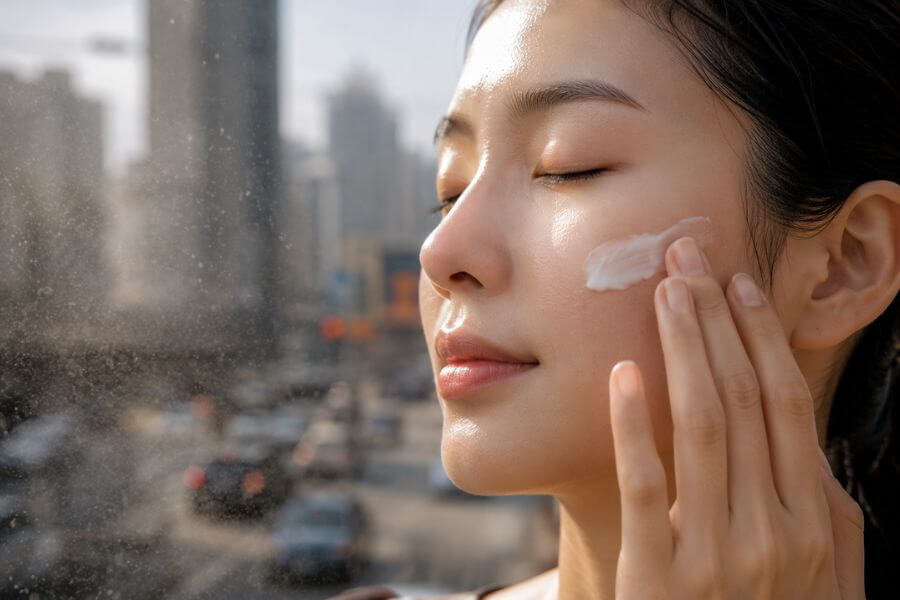
Key Takeaway
Urban environments expose your skin to toxic particles, gases, and heavy metals every single day. This microscopic debris triggers silent inflammation, clogs your pores, breaks down collagen, and speeds up fine lines and dark spots. Anti-pollution skincare acts like an invisible shield. By combining deep cleansing, powerful antioxidants, and strong moisture barriers, you can completely block these invisible aging factors and keep your face fresh, bright, and healthy.
The Invisible Threat in City Air
Living in a bustling city brings amazing energy, great food, and endless things to do. But while you are enjoying the bright lights and busy streets, your skin is fighting a silent war. The air in urban areas is packed with microscopic pollutants that you cannot see or feel. Every time you step outside, your face acts like a magnet for floating dust, car exhaust, and industrial smoke. These are not just tiny bits of dirt that you can easily wash off at the end of the day. They are highly reactive chemical compounds that actively damage your living tissue.
To understand why your face needs extra help in the city, you have to understand what is floating around you. Air pollution is a complex cocktail of different elements. You have gases like nitrogen dioxide, carbon monoxide, and sulfur dioxide. Then you have particulate matter, which scientists call PM for short. This particulate matter comes in various sizes, and the smallest ones are the most dangerous. They are so tiny that they can easily slip right into your pores and even penetrate the deeper layers of your skin.
When these foreign invaders park themselves on your face, they do not just sit there. They start a chain reaction of cellular stress. Your skin is your body’s largest organ, and its main job is to keep the bad stuff out while keeping the good stuff in. But urban pollution is a modern invention that our bodies did not evolve to handle on their own. The sheer volume of daily grime overwhelms your natural defenses, leading to dullness, irritation, and early signs of aging.
Understanding Particulate Matter and Gases
To truly protect yourself, you need to know exactly what you are fighting against. The air in cities contains two main types of polluters that target your skin health. The first type is particulate matter, and the second type is toxic gases. Both work in different ways to disrupt your complexion, and both require specific types of skincare ingredients to neutralize them.
Particulate matter is measured in micrometers. To give you an idea of how small this is, a single strand of human hair is about seventy micrometers wide. The dust particles floating through city streets are usually classified as PM 10 or PM 2.5. PM 10 includes things like soot, road dust, and pollen. PM 2.5 is even smaller and comes from car engines, wood burning, and power plants. Because PM 2.5 is thirty times smaller than a human hair, your skin pores look like giant open doors to them. They settle deep inside your tissue, carrying nasty chemicals along for the ride.
Toxic gases make up the other half of the urban air problem. Ground-level ozone is created when sunlight mixes with car exhaust. While the ozone layer high up in the sky protects us from the sun, ozone down on the street level is highly toxic to your skin cells. It strips away the natural oils that keep your face soft and hydrated. Nitrogen dioxide and sulfur dioxide also come from burning fuels. These gases irritate the surface of your skin, causing redness and making sensitive skin conditions feel much worse.
How Pollution Damages Your Skin Barrier
Your skin barrier is the outermost layer of your face. Think of it like a protective brick wall. The skin cells are the bricks, and natural fats and oils act as the mortar holding everything together. A strong barrier keeps moisture locked inside so your face stays plump and glowing. It also blocks bacteria, dirt, and pollution from getting inside. When you live in a city, this brick wall takes a daily beating from environmental stressors.
Pollution particles physically sit on this barrier and begin to degrade the mortar. The toxic chemicals dissolve the protective lipids, which are the natural fats that seal your skin. Once these fats are gone, small gaps open up in your protective wall. This leads to a double disaster. First, the water inside your skin starts to evaporate into the dry city air, leading to a condition called transepidermal water loss. This makes your face look dehydrated, flaky, and tired.
Second, those open gaps allow more pollution particles to travel even deeper into your skin layers. Instead of staying on the surface where they can be washed away, the chemicals get inside and interact with your living cells. This triggers an alarm system inside your body, causing your immune system to send inflammatory signals to your face. You might notice this as sudden redness, itching, burning, or a rough texture that never seems to go away no matter how much lotion you apply.
Signs of a Damaged City Skin Barrier
- Persistent dryness that does not improve with regular moisturizer
- Increased sensitivity to products that used to feel fine
- Random patches of red, itchy, or stinging skin
- A rough, uneven texture when you run your fingers over your face
- Sudden breakouts or tiny bumps that look like a rash
The Rise of Radical Oxygen Molecules
The most destructive weapon that pollution uses against your face is something called a free radical. Free radicals are unstable, highly reactive oxygen molecules that are missing an electron. Because they are unstable, they desperately want to steal an electron from somewhere else to become whole again. When pollution touches your skin, it generates billions of these angry free radicals on your face.
These unstable molecules start attacking your healthy skin cells to steal their electrons. They attack the lipids in your cell membranes, the proteins that keep your skin bouncy, and even your cellular blueprint material. This destructive process is called oxidative stress. It is very similar to what happens when you slice an apple open and leave it on the kitchen counter. The oxygen in the air turns the white apple flesh brown and mushy. That same browning process happens to your skin cells over time when they are constantly bombarded by city pollution.
Oxidative stress destroys the building blocks of young skin. It attacks collagen, which is the firm protein that keeps your face tight and smooth. It also destroys elastin, the protein that allows your skin to bounce back when you smile or blink. As free radicals chip away at these proteins day after day, your skin begins to sag, and fine lines start to form much earlier than they naturally should. It also triggers abnormal pigment production, leaving you with uneven dark spots.
The Link Between Air Quality and Breakouts
If you live in a crowded city, you might notice that your breakouts seem more frequent or harder to clear up. This is not a coincidence. There is a direct link between poor air quality and acne. When particulate matter and sticky smog settle on your face, they mix with your natural skin oils, which are called sebum. This mixture creates a thick, dirty sludge that sits right on top of your pores.
As this sludge hardens, it plugs up the openings of your pores. Your skin continues to produce natural oil underneath the plug, but the oil has nowhere to go. This creates the perfect, oxygen-free environment for acne-causing bacteria to multiply. To make things worse, the pollution particles oxidize the oils on your face. When sebum oxidizes, it becomes much thicker and stickier than normal, making it even more likely to form painful blackheads and deep, angry pimples.
Furthermore, the chronic inflammation caused by urban pollution weakens your skin’s ability to heal itself. When a normal pimple forms, a healthy body can usually calm it down in a couple of days. But in a highly polluted environment, your skin is already exhausted from fighting free radicals. The inflammation from the pollution joins forces with the inflammation from the bacteria, turning a small bump into a red, swollen, and long-lasting blemish that is much more likely to leave a dark scar behind.
Premature Aging and Dark Spots in Urban Areas
Many people think that the sun is the only thing that causes wrinkles and dark spots. While sun damage is a huge factor, recent scientific studies show that city pollution is a close second. Dermatologists have compared the skin of people living in clean, rural areas to those living in heavily polluted cities. Even when both groups spent the same amount of time in the sun, the city dwellers had significantly more wrinkles and dark spots on their faces.
This pollution-induced aging is often called atmospheric aging. The dark spots, also known as hyperpigmentation or age spots, happen because pollution activates the pigment-producing cells in your skin, which are called melanocytes. When these cells get irritated by toxic particles and gases, they go into overdrive. They start pumping out excess melanin, which is the brown pigment that gives skin its color. Instead of spreading evenly, this extra pigment clumps together in certain areas, creating patchy, uneven dark marks that make the complexion look older and less vibrant.
At the same time, the loss of collagen makes your skin lose its natural plumpness. Without a strong support structure underneath, your skin starts to deflate. You might notice lines appearing around your eyes and mouth, or a general loss of firmness along your jawline. The texture becomes less like silk and more like rough paper because the skin cells are not renewing themselves as fast as they should.
What is Anti-Pollution Skincare Exactly
With all these environmental threats, regular skincare products are sometimes not enough to keep your face fully protected. This is where anti-pollution skincare comes into play. This specialized category of products is specifically formulated to counter the unique dangers of living in a modern city. It is not just a marketing gimmick; it is a targeted approach to skincare that uses specific technologies to keep your face safe from urban grime.
Anti-pollution skincare works through three main methods. First, it uses physical blocking agents to create an invisible, breathable mesh over your face that prevents particulate matter from sticking to your skin or slipping into your pores. Second, it is packed with high concentrations of antioxidants that act like little bodyguards, sacrificing themselves to neutralize free radicals before they can cause damage. Third, it focuses on deep, gentle purification to lift stubborn toxic chemicals off your skin without stripping your natural moisture.
These products are formulated to be light and non-sticky. This is important because heavy, greasy creams can actually act like flypaper, trapping pollution particles against your face. Anti-pollution products are designed to glide on smoothly, leaving a clean, satin surface that repels environmental dust while flooding your cells with protective nutrients.
Key Ingredients That Block Urban Grime
When shopping for products to protect your city skin, you need to read the ingredient label carefully. You want to look for specific active compounds that have a proven ability to fight off the effects of pollution. These ingredients work together to shield your barrier, calm inflammation, and stop free radicals in their tracks.
One of the absolute best ingredients for urban skin is vitamin C. This powerful antioxidant is a master at neutralizing free radicals. When an unstable pollution molecule tries to steal an electron, vitamin C steps in and gives up one of its own electrons instead, saving your healthy skin cells from destruction. Vitamin C also helps fade dark spots and boosts your natural collagen production, making it a must-have morning ingredient.
Another incredible ingredient is niacinamide, which is also known as vitamin B3. Niacinamide is a multi-tasking superstar for city dwellers. It actively strengthens your skin barrier by encouraging your body to produce more natural fats. This seals up the gaps in your protective wall so pollution cannot get inside. Niacinamide also calms down redness, regulates oil production so your pores do not get clogged by sticky smog, and stops pigment from clumping into dark spots.
Essential Anti-Pollution Ingredients
- Vitamin C: Neutralizes free radicals and brightens dark spots.
- Niacinamide: Strengthens the skin barrier and calms redness.
- Vitamin E: Protects cell membranes from oxidative stress.
- Ferulic Acid: Boosts the power of vitamin C and vitamin E.
- Hyaluronic Acid: Floods dehydrated skin with deep moisture.
- Activated Charcoal: Draws deep-seated pollutants out of pores.
- Green Tea Extract: Soothes inflammation and fights environmental damage.
The Power of Antioxidants in Your Routine
To understand why antioxidants are so vital for city skin, imagine a game of dodgeball. The pollution particles are throwing balls at your healthy skin cells, trying to knock them out. Antioxidants are like a team of loyal shields that jump in front of the balls to protect your cells. They take the hit so your skin does not have to.
Using just one antioxidant is good, but using a blend of different antioxidants is much better. Different antioxidants work in different parts of your skin cells. For example, vitamin C works in the watery parts of your skin, while vitamin E works in the fatty parts, like the cell membranes. When you combine them, they create a complete network of defense that covers every single angle.
You should apply an antioxidant serum every single morning after cleansing your face. This creates a fresh layer of protection right before you step outside into the morning traffic and smog. By applying them early, you ensure that your skin has a full supply of defense molecules ready to fight off the environmental stress of the day.
Morning Shielding Strategy
Your morning skincare routine in the city should be all about defense and protection. You want to prepare your face to face the elements, creating a strong barrier that keeps toxic particles at bay. It does not need to take an hour, but it does need to be strategic.
Start with a very gentle cleanser. You do not want to scrub your skin raw in the morning because that weakens your protective wall before you even leave the house. Just use lukewarm water or a mild, hydrating wash to clear away any sweat or oils that accumulated while you were sleeping. Pat your face dry with a clean towel.
Next, apply your antioxidant serum. Press it gently into your skin and let it absorb for a minute. Follow up with a lightweight, barrier-strengthening moisturizer that contains ingredients like ceramides or niacinamide. This locks in the antioxidants and seals your protective wall. The final and most important step is sunscreen. Sunscreen is not just for the beach. UV rays from the sun actually combine with air pollution to make the damage twice as bad. Look for a broad-spectrum sunscreen with an SPF of thirty or higher that contains zinc oxide or titanium dioxide, as these minerals provide a physical shield that helps deflect floating dust particles.
Evening Detoxification Routine
While your morning routine is all about defense, your evening routine should focus entirely on deep cleansing, detoxification, and repair. When you come home after a long day in the city, your face is covered in an invisible film of grease, dust, and toxic chemicals. You need to remove this film completely before you go to sleep so your skin can breathe and repair itself overnight.
The most effective way to clean city skin is a method called double cleansing. For your first cleanse, use an oil-based cleanser or a cleansing balm on dry skin. Oil dissolves oil, so this step easily breaks down stubborn makeup, water-resistant sunscreen, and the oily pollution sludge that has built up in your pores during the day. Massage it around your face for a minute, then rinse it off with warm water.
For your second cleanse, use a gentle, water-based foaming or gel cleanser. This step cleanses the actual skin surface and washes away any remaining dirt, sweat, and pollution residue. By cleansing twice, you ensure that your pores are completely clear. Once your face is perfectly clean, apply a repairing night cream packed with peptides and soothing botanical extracts to help your skin rebuild its barrier while you rest.
The Role of Exfoliation in City Skin Care
Because urban pollution clogs pores and slows down your skin’s natural shedding process, regular exfoliation is a critical step for city dwellers. Exfoliation means removing the dead, dull cells that build up on the surface of your skin. If you do not remove these dead cells, they trap pollution particles underneath them, leading to a dull complexion and frequent breakouts.
However, you must be careful not to overdo it. Harsh facial scrubs with sharp, jagged particles can create microscopic tears in your skin barrier, making it even easier for pollution to get inside. Instead, look for gentle chemical exfoliants like alpha-hydroxy acids, which are called AHAs, or beta-hydroxy acids, known as BHAs.
AHAs, like glycolic acid or lactic acid, work on the surface of your skin. They gently dissolve the glue holding dead cells together, revealing bright, fresh skin underneath and fading city-induced dark spots. BHAs, like salicylic acid, are oil-soluble. This means they can dive deep inside your pores to dissolve the sticky oil and pollution plugs, making them incredible for preventing city acne. Use these exfoliants just two or three times a week at night to keep your skin smooth and clean without causing irritation.
Dietary Support for Environmental Defense
What you put inside your body is just as important as what you put on the outside when it comes to fighting urban pollution. Since pollution creates oxidative stress throughout your system, you can boost your skin’s defenses by eating a diet that is incredibly rich in natural antioxidants. This creates an internal shield that helps your body fight off free radicals from the inside out.
Fill your plate with bright, colorful fruits and vegetables. Berries like blueberries, strawberries, and blackberries are packed with vitamins and compounds that destroy free radicals. Leafy greens like spinach and kale provide a massive dose of vitamins A, C, and E. Oranges, bell peppers, and tomatoes are also fantastic choices for boosting your daily vitamin C intake.
Healthy fats are another essential component of an anti-pollution diet. Omega-3 fatty acids, which you can find in salmon, walnuts, chia seeds, and flaxseeds, help build strong, healthy cell membranes. These healthy fats strengthen your skin barrier from within, keeping your face soft, hydrated, and resilient against environmental irritation. Do not forget to drink plenty of water throughout the day to flush toxins out of your body and keep your skin cells plump.
Creating a Clean Indoor Sanctuary
Many people assume that they are safe from pollution once they step inside their homes or apartments. Unfortunately, indoor air can sometimes be just as polluted as outdoor air, if not worse. Cooking gases, dust mites, pet dander, and outdoor pollution that blows in through open windows can trap toxic particles inside your living space, where they continue to stress your skin.
To protect your face while you sleep and relax, you need to turn your home into a clean air sanctuary. One of the best investments you can make for your skin and overall health is a high-quality air purifier equipped with a HEPA filter. HEPA filters are capable of trapping over ninety-nine percent of tiny airborne particles, including PM 2.5 dust, smoke, and allergens. Place the purifier in your bedroom since that is where you spend eight consecutive hours every night.
You should also wash your pillowcases and bedding frequently. Pollution particles from your hair and face rub off onto your pillow every single night. If you do not wash your pillowcase regularly, you are pressing your face right back into that collected city grime every time you go to sleep. Aim to change your pillowcase at least once or twice a week, and consider using a silk or satin material, which is gentler on your skin barrier and does not absorb your expensive face creams.
Anti-Pollution Skincare vs. Regular Skincare
It helps to understand exactly how specialized anti-pollution products compare to standard skincare items. While standard products focus on basic hydration and anti-aging, anti-pollution products are specifically engineered to fight environmental toxins.
| Feature | Regular Skincare | Anti-Pollution Skincare |
| Primary Goal | General hydration, basic aging care | Environmental defense, detoxification |
| Texture | Can be heavy, rich, or greasy | Lightweight, breathable, non-sticky |
| Antioxidant Level | Standard or low concentrations | Very high, multi-network concentrations |
| Pore Protection | Does not prevent particle adhesion | Forms a breathable film to repel dust |
| Barrier Support | Basic moisture replenishment | Active ceramide and lipid rebuilding |
| Purifying Action | Surface cleansing only | Deep-pore extraction of heavy metals |
Choosing the Right Products for Your Skin Type
Every person’s face is unique, and your anti-pollution strategy should match your specific skin type. A product that works wonders for someone with oily skin might cause irritation for someone with dry skin. You want to tailor your routine so you get maximum protection without disrupting your natural balance.
If you have oily or acne-prone skin, look for lightweight, water-based gels and fluids. Avoid heavy oils that can combine with city smog to clog your pores. Focus on products containing salicylic acid to clean out your pores, and use a niacinamide serum to control oil production while protecting your barrier. Clay masks used once a week are also excellent for soaking up excess city oil.
If you have dry or mature skin, your main goal is to repair the moisture barrier and lock in hydration. Look for rich creams that contain ceramides, fatty acids, and hyaluronic acid. These ingredients will seal up any gaps in your skin wall caused by toxic gases like ground-level ozone. Use a rich, oil-based first cleanser at night to melt away pollution without stripping away the precious natural oils your skin desperately needs.
For those with sensitive skin, city pollution can cause constant redness and stinging. Stick to fragrance-free formulas with minimal ingredients to avoid triggering a reaction. Look for soothing compounds like centella asiatica, green tea, or chamomile extract. These ingredients calm the internal alarms triggered by pollution particles, bringing peace and balance back to an irritated face.
The Long-Term Benefits of Protective Habits
Consistency is the ultimate secret weapon in skincare. Protecting your face from urban pollution is not something you do once a week or only when the air quality index looks bad. It is a daily habit that pays off massively over time. When you protect your skin barrier every morning and clean it thoroughly every night, you are investing in your future appearance.
In the short term, a dedicated anti-pollution routine will make your skin look brighter, smoother, and more hydrated. You will notice fewer random breakouts, less redness, and a clean, fresh glow that stands out even in the middle of a smoggy city afternoon. Your makeup will glide on smoother because your skin texture is no longer rough from trapped dust.
In the long term, you are actively slowing down the clock. By neutralizing free radicals before they can chop away at your collagen, you preserve the natural bounce and firmness of your face. Ten or twenty years down the road, your skin will look significantly younger, tighter, and clearer than it would have if you had left it unprotected against the harsh realities of city air. You get to enjoy all the incredible perks of city life without letting the city leave its mark on your face.
Frequently Asked Questions
Can I just wear makeup to block city pollution from reaching my face?
While some liquid foundations and face powders can provide a very minor physical barrier against larger dust particles, makeup alone is not enough to protect your skin from urban air. Most makeup products do not contain the high concentrations of antioxidants needed to neutralize free radicals, nor do they have the specific barrier-repair ingredients to heal gaps caused by toxic gases. Furthermore, chemical pollutants and tiny PM 2.5 particles can actually bind to your makeup, trapping the toxins against your skin surface for hours. It is much better to apply a dedicated antioxidant serum and mineral sunscreen underneath your makeup to create a true defensive shield.
How do I know if the air pollution in my city is actually damaging my skin?
If you live in an urban area and notice that your face frequently feels dull, rough, or dry despite using moisturizer, pollution is likely affecting your skin. Other common signs include sudden redness or sensitivity to products that used to feel totally fine, an increase in blackheads and clogged pores, or dark spots appearing even when you wear sunscreen. If your skin looks tired and gray at the end of the day but looks much brighter when you travel away from the city to rural or coastal areas, that is a clear indicator that urban air quality is taking a toll on your complexion.
Is it necessary to use anti-pollution skincare if I spend most of my day indoors?
Yes, it is still highly beneficial to use protective products even if you work or study indoors all day. Outdoor pollution easily travels inside through open windows, doors, ventilation systems, and on your clothes and hair. Additionally, indoor spaces have their own unique air quality issues, including gases from cooking stoves, dust, and chemical residues from cleaning products. Spending time around computers, phones, and indoor lighting also exposes your face to blue light, which can combine with indoor air pollutants to increase oxidative stress and accelerate skin aging.
Should I change my skincare routine on days when the air quality index is low or safe?
Even on days when the official air quality index is listed as safe or low, urban areas still contain a baseline level of car exhaust, industrial emissions, and floating dust that is much higher than in nature. While you might not need to do heavy detoxifying masks on clean days, you should absolutely maintain your core routine of using an antioxidant serum, a good moisturizer, and sunscreen every morning, followed by a thorough cleanse at night. Consistency is what builds a resilient skin barrier, and keeping your defenses up every day prevents cumulative, microscopic damage over time.
Can teenagers and young adults use anti-pollution skincare products safely?
Absolutely. Anti-pollution skincare is perfectly safe and highly recommended for teenagers and young adults living in cities. Since the primary goals of these products are gentle cleansing, antioxidant protection, and barrier repair, they do not rely on harsh or aggressive anti-aging chemicals that might upset young skin. In fact, starting a simple anti-pollution routine early is one of the smartest things a young person can do, as it helps prevent the clogged pores, city-induced acne breakouts, and early collagen damage before they ever become a major problem.